
Wine as a wave—in cycles
The Crest and the Trough
Wow. We’ve been through some seismic shifts in this first quarter of the 21st Century: 9/11 in 2001, then the Pandemic of 2020-23. Life as we knew it, across many facets of human endeavor, would never be the same. Further disruption is afoot, it seems. And the wine world is feeling it.
Currently, there is much hand-wringing over declining interest in wine and the disappearance of the wine consumer. The situation is real enough but, in my view, it is yet another turn in the cycle of booms and busts that occur periodically in the world of wine, awaiting another turn in the inevitable cycle. The trough of a wave, idling on the surface while underneath an upward surge is building.
It may be a lengthier dip this time, taking longer than the year, two years, three to five years of previous slumps over the fifty or so that I’ve been observing them. Today there are mightier forces at work: catastrophic climate change; stratospheric pricing (spurred by the irrational exuberance of gazillionaires?); younger generations with many more choices in recreational substances—drinkable or smokable; a glut of uninteresting wines that are mass-produced and stuffed with additives (thousands are permitted in the manufacture of so-called “wine”), so mediocre it’s no wonder consumers are bored with them. Not worth the cost to the liver. Which brings in another impact: the health-and-wellness movement, currently a hefty societal force that eschews all alcohol as toxic.
A Few Words for the Oenophile. Assuming there still is such. Oenophile: lover of wine. I had them in my wine classes—in New York, in Oxford (MS), in Durham at Duke: young professionals curious about the somewhat mysterious substance that was written about (by wine writers like me) in the magazines and newspapers they read; curious about the high-shouldered or tapering bottles they saw on restaurant tables, the dazzling (and daunting) array of labels in wine shops. Eager to know the differences among them, what was good, and why, and above all, how to choose. Wine has intrigued humans for eight thousand years. A dip in interest might bring about some much needed pruning. A reassessment, a bit of weeding out.
If you want to experience wine of genuine character, with nuance of scent and layers and facets of flavor known as complexity—you will have to pay for it in two ways: money and time. Wines from good vineyards and gifted winemakers cost more. They need time to achieve their potential—which is to taste great, possibly extraordinary. It takes years—in a consistently cool, dark, still place, where time—and only time—can allow the magic to unfold: the mingle of elements (fruit, acids like tannin, malic and tartaric, alcohol, oak influence), the blending, the weaving, the process of maturing. Hey, it takes twenty-one years for a human to come of age, longer to be thought of as mature—why so surprised that a wine with exceptional potential requires a decade, often two? Alas, such wines seldom get to loll in time for that long—but I can well attest to the rewards of allowing it, and have.*
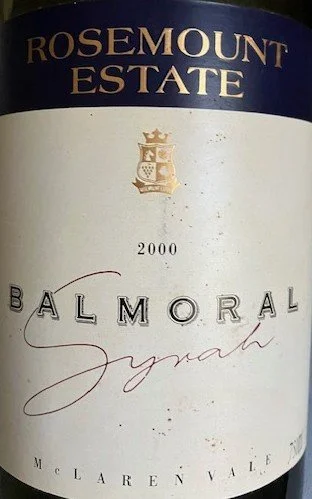
Most recently: Rosemount Estate Balmoral Syrah 2000, from the cool coastal vineyards of McLaren Vale near Adelaide, South Australia.
Decanted 30-40 minutes before pouring to accompany braised duck legs in a shiraz and prune sauce. The meal was fantastic and the wine a lovely complement—dark and vibrant, incredibly well-balanced, utterly smooth and rich in texture, with alluring flavors of blackberry, dark cherries and plums. Google this wine and you may find it for $70 or so; more available are Balmoral 2018 and 2016, which at age ten should be excellent now, though probably better at twelve to fifteen.
The critical key to successfully aging wine is having something to drink and enjoy in the meantime. Here’s where you can explore more affordable choices for everyday drinking, ranging from $15 to $25 a bottle—like the “Summer Reds” of my previous Substack—or the plethora of bright white wines, such as Gruner Veltliner of Austria, Pinot Blanc of Alsace, marsanne-roussane blends from the Rhône and Provence, Italy’s brisk Verdicchio and Vermentino. Sauvignon Blancs are having a big moment this year—excellent ones from the Loire, New Zealand, Sonoma, Chile. I recently was smitten by the scintillating 2024 Spy Valley SauvignonBlanc from Marlsborough, NZ ($18) with its lemon-lime accents and ripe pear notes. Some others to look for: Starborough, Whitehaven, Giesen and Grey Rock.
So…lay down a few good reds and leave them be. Time flies, ever faster these days. In a decade or two, the payoff will be at hand—and in your glass. You’ll be glad. Santé!
*See also: https://www.bewinewise.com/cellar-sleuthing
https://winewisewithbarbaraensrud.substack.com